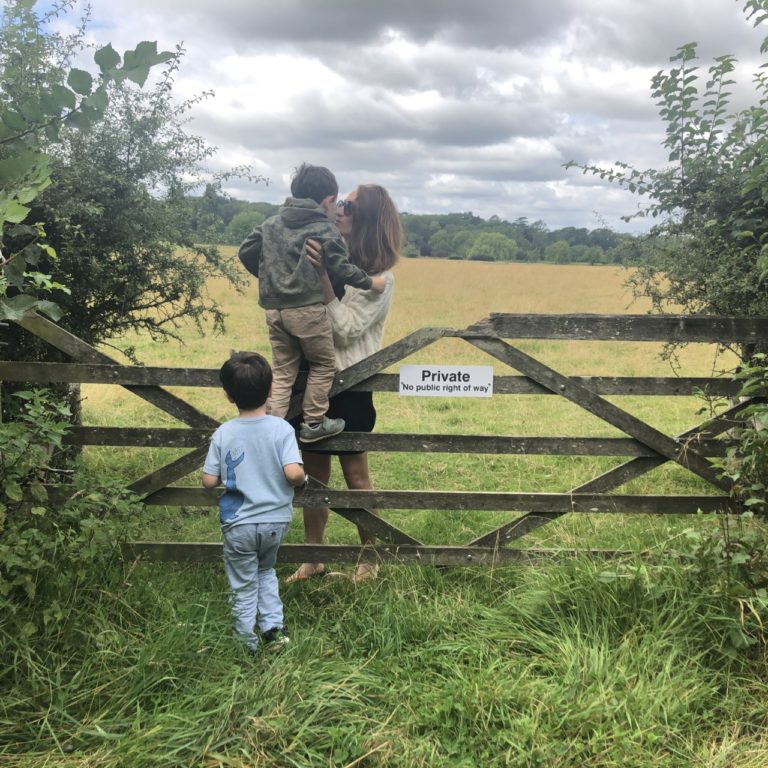
Does Showing your Child’s face online make you a bad mother?
More and more, we are being told that keeping our children offline is the responsible choice. But has fear of online abuse become another stick with which to beat mothers – and is disappearing really the best answer we have?
I have found myself doing something recently that I am not especially proud of.
I’ll be scrolling through Instagram when I see a close-up of a child: smiling, bright-eyed, every feature perfectly visible.
My first thought is no longer simply that they look happy. It is: gosh, that mother is brave. Should she still be showing their face like that?
And there it is – the judgement.
Showing your children online has become the latest test of good motherhood. Keep them offline and you are responsible. Show their faces and you are increasingly seen as reckless, naive or prepared to trade their safety for attention.
There was a time when women who shared their children online were dismissed as performative. Now they are deemed dangerous. It is beginning to feel like another stick with which to beat mothers.
The risks are real. Images can now be copied, manipulated and circulated in ways no parent-or child-ever consented to. The way I share my own children is changing too.
But I am uncomfortable with where the conversation is taking us. When did the sight of an ordinary child become transgressive – and when did making women and children disappear become the best solution we could offer?
The danger is real but whose responsibility is it?
In November 2025, Ireland’s Data Protection Commission launched Pause Before You Post. Its advert showed a young girl approached by strangers who knew details of her life from information her parents had shared online.
It was deliberately unsettling and, on one level, effective. Of course we should think carefully about the information we reveal about our children. A photograph can expose far more than a face: a school, a routine, a football club or a location.
Yet I came away from the campaign feeling angry. Its wording was ‘pause’, not ‘keep your children offline’, but the emotional message still landed squarely with the parent: you shared this, and now your child is at risk.
If public bodies can invest in warning parents about photographs, we should also ask what they are doing to pursue the people who steal and manipulate them, and to force platforms to stop enabling it.
Women have spent decades being told to change their behaviour to avoid male violence: do not walk home alone, do not wear the short skirt, do not attract the wrong kind of attention. The suggestion that a parent created the danger by sharing a photograph feels horribly familiar.
Visibility is not consent to abuse.
This does not stop with children
In September, The Guardian reported that Meta’s Oversight Board ordered the removal of two AI-generated deepfake videos and criticised the company’s safeguards. The targets were adult women taking part in public life: a Scottish councillor and a young Muslim campaigner.
That matters because the same technology used to sexualise or humiliate children can also be used to harass women with voices, opinions and public influence. The only people I personally know who have experienced image-based abuse are grown women. That does not make the danger to children less serious. It suggests a wider problem of violence against women and children – not one that mothers can solve by removing small faces from Instagram.
So what happens after the children disappear? Do women begin to disappear too? Do we replace our families with polished AI approximations because showing an actual human face has become too risky?
Real childhood is missing teeth, different bodies, disability, unruly hair and emotions that do not fit an AI preset. An internet populated by synthetic families may look safer, but it will also be less truthful.
A child can be included without being exposed
Defending a child’s right to be represented does not let parents, myself included, off the hook. Children cannot give adult, informed consent to a permanent digital record. They may dislike an image later or resent a childhood moment becoming part of their mother’s work. When money is involved, that imbalance is harder to ignore.
But there is a meaningful difference between a child appearing briefly in a family day-out reel and their distress, illness, embarrassment or most private moments becoming the product.
A child can be included without being exposed.
The way I share my children is changing. I think more carefully about what the content reveals and whether a moment should remain theirs. My older children can say no. I avoid vulnerable moments and information about schools, routines or real-time locations.
I expect those boundaries to keep moving as my children grow. There is no single decision I can make now that settles the matter forever.
And I keep returning to the children who actively want to perform or be seen. When I was at school, three sisters in my class went to stage school. They were always leaving for auditions and appearing in adverts, and I remember thinking they were impossibly cool.
Appearing in an advert is not the same as appearing in your mother’s Instagram reel, and children can be exploited in traditional media too. But if the risk attached to a child’s face is now considered unacceptable, where does that logic end? Do we stop casting children in advertising, television and film? Do we warn a talented child away from performing because somebody might misuse their image?
We tell children, and girls particularly, to find their voices and enter the world with confidence. We cannot also teach them that the price of safety is making themselves smaller.
Another test of good motherhood
Perhaps this is why the conversation feels so loaded. It begins with a valid concern about children’s privacy, then quickly becomes another verdict on whether a woman is mothering correctly.
Screen time, childcare, breastfeeding, school, food, work, sleep. Mothers are always doing too much of something and not enough of something else. Now showing your children online has joined the list.
There is also a reality about work that gets lost in the outrage. Motherhood involves an enormous amount of invisible, unpaid labour. Many women create content in the cracks around caring because conventional work does not accommodate their lives, or because childcare is unaffordable. Then we tell them that the daily life consuming almost all of their time is morally off limits as something from which they might earn.
That does not make every form of family content defensible. Children should not be responsible for the household income, and we need better protections around privacy and earnings. But the blanket assumption that a mother showing her family is exploiting them feels both lazy and, often, misogynistic.
I have absorbed some of that judgement myself. I hear it in the little voice that says ‘brave’ when I see somebody else’s child smiling into the camera. Social media is an echo chamber, and moral certainty travels particularly well inside it.
Where I draw the line
I am not trying to persuade every parent to show their children. Keeping a child offline is a reasonable choice, and for some families it will be the right one.
For now, I will continue to show my family, but more carefully and probably less often. I will keep questioning what belongs to my children and what belongs to me.
The answer must also include stronger laws, safer platforms and meaningful consequences for the people who commit these crimes. It cannot simply be: mothers, stop posting.
Pause before we post, yes. But perhaps we should pause before we judge, too.
Thoughtful Takes on modern motherhood, plus the best of London for families – delivered weekly
READ NEXT: The Luxury Buggy Edit 2026: Who are these buggies actually for?